
No matter what temperature we dialed in, nothing ever seemed to actually reach it. Bake element tested weak under load, replaced it and it holds temperature accurately now.
Ezekiel W.
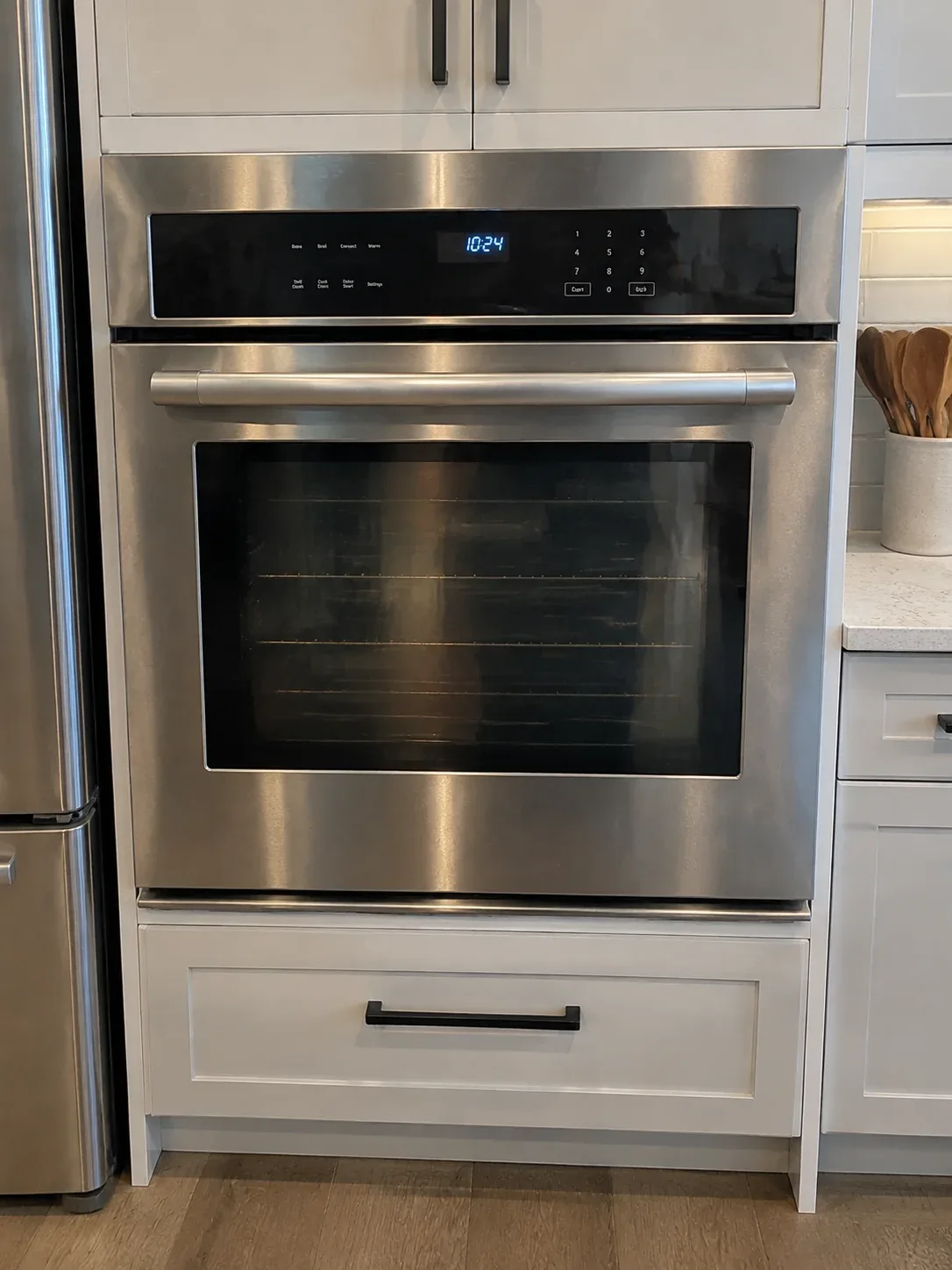
An oven that's lost its heat, bakes with one side darker than the other, or shows a blank screen usually needs one part fixed, not a full replacement.
Select what's happening below for a plain explanation of the likely cause.
Never Gets As Hot As It Should
You set it to 375 and something baked at that temperature just isn't turning out right, coming out pale or undercooked past when it should be done. A bake element that's partially failed is the most frequent cause on electric ovens, confirmed by testing its output directly under an actual load rather than judging by appearance alone. A weak igniter shows the same pattern on gas models. We measure rather than guess before recommending any part.
Preheat Drags On And On
Ten minutes used to be plenty to get up to temperature, now you're waiting closer to twenty before it signals ready. This is almost always a gradual decline rather than a sudden break, a weakening igniter on gas units or a bake element slowly losing output on electric ones. We track heat output across the full preheat window rather than a single reading, since that's what actually reveals the slow decline.
One Side Bakes Darker
A tray centered dead in the middle still comes out browner on one side than the other, consistently, batch after batch. A convection fan that's stopped spinning is the frequent explanation, without it circulating air the heat simply isn't distributing evenly across the cavity. A heating element with an uneven hot spot somewhere along it can create the same kind of pattern. We run a test bake to actually map where the unevenness is coming from.
Heat Escaping Around The Door
You can feel warmth leaking around the door edges even though it looks and sounds fully closed. Usually a door gasket that's lost its original shape and can no longer press evenly against the frame, or hinge tension that's loosened enough over time to leave a slight gap. We inspect both together, since replacing just one when the other's also worn rarely fixes it completely.
Nothing Shows On The Panel
Buttons don't register anything at all, the screen's gone completely dark with no backlight whatsoever. A loose ribbon connector behind the control panel is a common and far cheaper cause than an actual board failure. We reseat and test that connection first, since it's a five-minute fix when that's genuinely the issue.
Self-Clean Won't Complete
The cycle gets partway through and either stalls or throws an error, sometimes leaving the door locked shut afterward with no obvious way to open it. The typical reason is a door lock switch that isn't triggering in the precise order the board is programmed to expect, which it then interprets as unsafe and stops the cycle. We test that lock sequence directly rather than forcing a reset that might not actually hold.
Still Not Sure What's Wrong?
Skip the guesswork, one visit is usually enough to sort it out for good.
Real parts, real training on each of these, not a generic fix-it-all approach.










Codes vary by brand, but these patterns show up across most major oven manufacturers.
| Code | What It Usually Points To |
|---|---|
| F1 / F3 | A control board or temperature sensor fault has been detected. |
| F2 / F30 | The oven cavity has overheated beyond its safe operating range. |
| E2 | The temperature probe is reading outside its expected range. |
| dL / door | The self-clean door lock is engaged and won't release yet. |
| PF | A power interruption was detected, the clock likely needs resetting. |
| F5 | A stuck or unresponsive key on the control panel has been detected. |
Exact codes differ between manufacturers, so treat this as a general guide, not a replacement for your model's manual. If a code keeps returning after a power reset, book a visit and we'll read it properly.
A handful of oven complaints trace back to something quick you can verify yourself, safely and without any tools.
Test with an oven thermometer. A cheap oven thermometer confirms whether the actual temperature matches the dial. A gap of more than 25 degrees is worth reporting to us.
Check the door seal by hand. Run your hand around the door edge while it's heating to feel for escaping heat. A flattened or torn gasket is a common, inexpensive fix.
Confirm power or gas supply. Check the dedicated breaker for electric ovens, or confirm the gas valve is fully open for gas models.
Make sure self-clean isn't locked. If the door won't open, check whether the self-clean cycle is still running or hasn't fully released the lock yet.
Clean the oven racks. Built-up grime can stop racks from sliding smoothly, which sometimes gets mistaken for a door or hinge problem entirely.
Check for tripped breakers after a storm. A partial power loss can affect the control board without cutting power completely. Reset the breaker and see if the display responds.
Still acting up after trying these? Something deeper is probably going on. Get a technician out and we'll take it from there.
What customers said after we sorted out their oven.
Send us your details and we'll reach out to lock in a time.
Thank You!
Your message has been sent successfully. We'll get back to you shortly.
Thank You!
Your message has been sent successfully. We'll get back to you shortly.
Prefer to talk it through? (214) 305-2364